Alligt gives Bike2’s pedal generator a new life
Comments Off on Alligt gives Bike2’s pedal generator a new lifeAlligt, Dutch manufacturer of plastic wheels and parts for cargocycles and velocars, is giving Bike2’s pedal generator a new chance. Even though the Danish company has invested a lot of energy in the concept over the past 12 years, they have ultimately not yet managed to bring a finished product to market. Maybe they were too far ahead of their time. LEVA-EU Member Alligt was among one of their first customers and worked with Bike2 to test the pedal generator. Alligt and Bike2 recently entered into an agreement that allows Alligt to continue the work. Bike2 can expect a market-based royalty to compensate for their investment over the past 12 years.
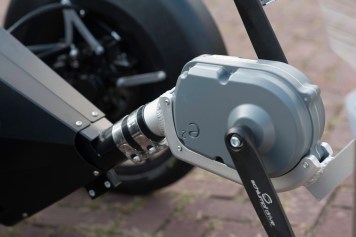
Through the agreement, Alligt acquires Bike2’s patent and can relaunch the human serial hybrid pedal generator. This concept offers a very suitable solution for cargo bikes. Alligt knows the cargo bike market well, having acquired a very extensive network with the development and production of plastic cargo wheels. Alligt managing director, Leo Visscher, is convinced that many of those companies are interested in a low-maintenance drive system. “Those who don’t think a plastic wheel is crazy will undoubtedly not find a pedal generator an absurd idea either,” Leo says.
The product is a pedal drive in which a bicycle’s chain is replaced by an electric clutch with optimal chain feel, supplemented by energy from a battery. Alligt believes this product can encourage healthy exercise by riding a lightweight vehicle. Alligt also thinks that the pedal generator contributes to safety. The system still requires the cyclist to pedal at a reasonable rate to achieve efficient acceleration and speed. Alligt believes that a maximum acceleration of 1.5 m/s2 is a good limit for all vehicles on the road. The system also allows people with very little muscle power to propel themselves independently. Moreover, this system allows you to pedal yourself warm in cold weather.
It is now clear that the market for serial hybrid systems in cargocycles and velocars is really taking off. The advantages of this system for cargocycles and velocars include good control of the vehicle, which is even more important in urban areas, and the design freedom created by omitting the chain. In addition, the system allows for riding in reverse, even regenerating energy via the motor.
In order to bring Bike2’s bottom bracket generator to the market, quite an effort is still needed, especially regarding available components and adaptation of the software for a new prototype. This new prototype could be tested with the Golo cargo bike from LEVA-EU Member Flevobike, another Dutch company that has been cooperating for years to improve the pedal generator. After initial testing with the Golo, a Beta version could be tested widely in the market. However, this plan requires additional investments.
Therefore, Alligt is looking for partners interested in financial support and/or partners interested in producing the system. Alligt is already convinced of the potential of the Bike2 system. The number of suppliers of serial hybrid systems is still quite limited. Moreover, the system is suitable for various target groups, not only for cargocycles, but for instance also for hometrainers or for bikes for users with physical problems.
Should a major party be interested in taking over this project in its entirety from Alligt, that too is negotiable. Alligt’s objective in taking over the patent was to bring more pedal generators to the market for different target groups and make them available to small innovative companies. Fifty per cent of such a take-over will go to Esquare, the company behind bike2.dk.
More information can be found at Alligt.nl. Their Cargobike wheels can be seen at cargobike-wheels.com cargobike-wheels.com. For further details, please contact leovisscherkorver@gmail.com.